
AI has been elevated to its own standalone risk category in a lot of major governance reporting recently, and an adoption slide by itself isn’t enough anymore. This comes both from reading through what outlets like CFO Brew and Accounting Today have been covering, and from my own work consulting with PE-backed companies and watching what their boards actually ask about.
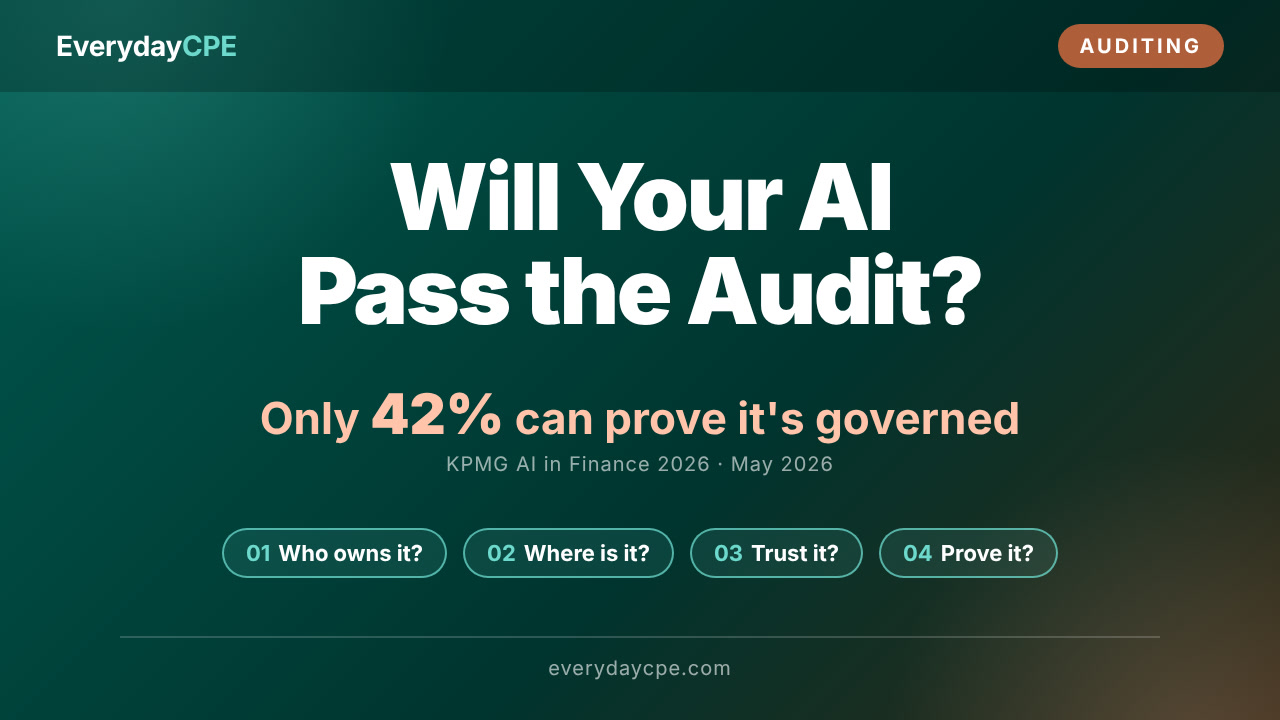
Boards increasingly know that AI ownership is unresolved at most companies. That’s slowly improving, but for now, most boards have been reasonably tolerant of AI being “owned” by committee. Some companies have created chief AI officer roles. But in general, ownership stays fuzzy — and an update that doesn’t name an owner implicitly raises that exact question in the room, whether or not anyone asks it out loud.
There’s a real fight happening over who that owner should even be. The CIO has a claim — it’s a technology system, another piece of the stack, and a lot of the core usage sits with people already in the CIO’s world. But AI’s impact reaches well outside a CIO’s usual purview, and it doesn’t behave like a normal piece of enterprise software you can just manage access and security for. The COO has a claim — a lot of the real impact shows up in how operational work actually gets done day to day. I’d personally argue the CFO is often the strongest candidate, because at the end of the day this is a budgeting and returns question, and the CFO holds the most granular, most trusted financial data to make a verifiable claim about what AI is actually costing and returning. When someone outside the CFO makes a claim about AI’s impact, boards tend to ask what the CFO thinks of it anyway — so that credibility already exists, and it’s worth using. There’s also a case for the chief risk officer, given how large a risk surface AI represents, and a case for the chief data officer, since AI is only as good as the data underneath it, and that person usually has the clearest picture of what it should and shouldn’t be allowed to touch.
I’ll say directly: I don’t think chief AI officer is a role with staying power. It’s a useful signal right now — it shows a company is taking this seriously — but I think AI eventually settles the way Excel did. Everyone across the organization uses it. Nobody has a chief Excel officer. You’ll still have a CIO managing the underlying platform relationship and a chief data officer helping keep the data clean, but a dedicated, permanent AI ownership role feels like a fad more than a long-term structure.
If you’re not the one presenting to the board, the practical move is answering this question for your own corner of the org. If you’re in accounting, who owns AI in accounting? If you’re on the tax provision team, who’s the AI champion there? Having a real answer to that — and being able to say it clearly — is what filters up and makes you the person leadership turns to when the board’s questions eventually land on your desk. And if that role doesn’t exist yet in your area, that’s either a gap you could step into or one worth flagging to your own leadership, because it’s exactly the kind of thing boards are starting to expect an answer for.
Beyond naming an owner, the update itself needs two things most AI board sections are still missing: a real spend-and-return figure, treated with the same rigor as any other material line item, and specific governance for the parts of AI touching financial processes — not a general company-wide AI policy statement, but the actual guardrails around the numbers the board is ultimately accountable for.
Key takeaways
- AI has moved from a footnote under general technology risk to its own standalone risk category in major governance reporting.
- Boards increasingly know AI ownership is unresolved at most companies — naming an owner in your update closes that gap before it gets asked about.
- An adoption percentage is no longer a sufficient AI update on its own.
- Include a real cost-and-return figure, treated the way you’d treat any other material spend area.
- Address governance specifically for AI touching financial processes, not a general company-wide policy statement — and know who owns AI in your own corner of the org, even if you’re nowhere near the boardroom.
Want the CPE credit? Take the full lesson on EverydayCPE and earn 0.2 CPE credits: The AI Update Your Board Deck Is Probably Missing
Leave a Reply