Learning Objective: By completing this Nano Learning course, participants will be able to:
- Estimate how much of your own work AI can take on by scoring each task on capability, who does the work, and time with AI including review
- Evaluate AI time-savings assumptions in staffing plans and business cases by checking whether they count review time
Category: Technical > Management Services
Level: Basic
Credits: 0.2
Prerequisites: None
Advance Prep: None
Delivery Method: Nano Learning
Lesson summary
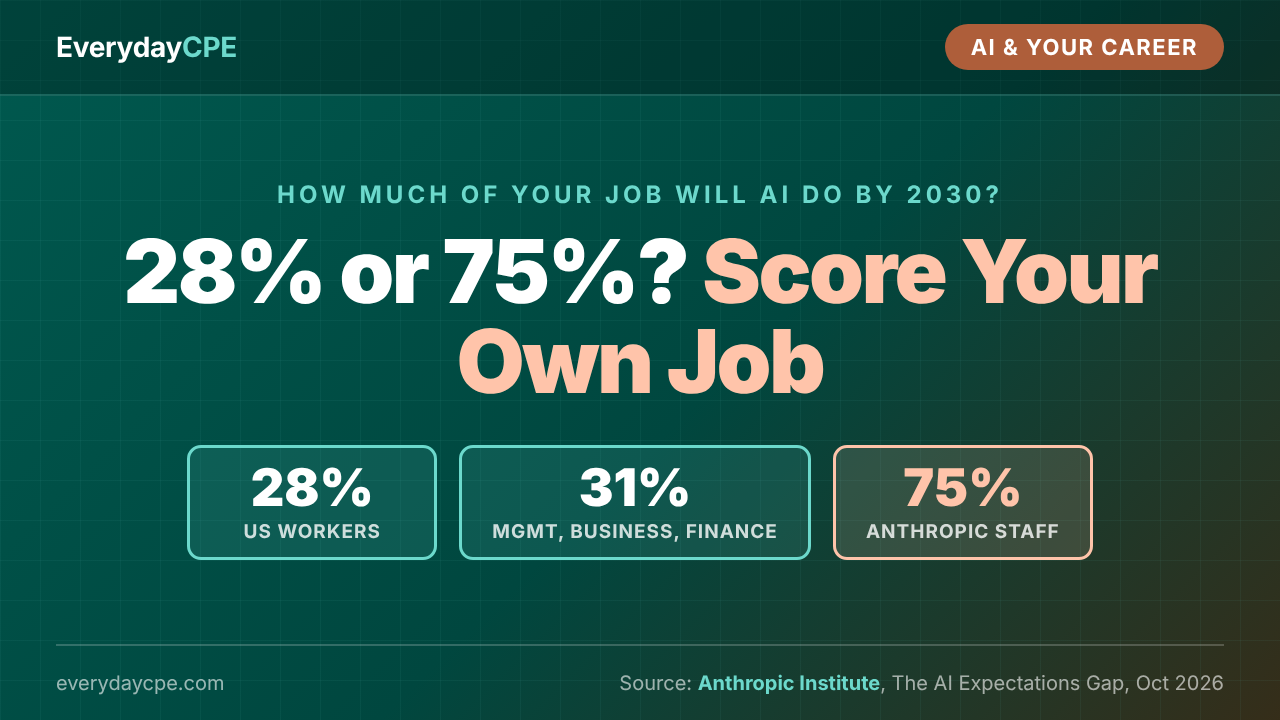
In October 2026, the Anthropic Institute asked 10,980 US adults and 1,334 of its own staff the same question: how much of your current work hours will AI be able to do by 2030? The average US worker said 28%. Management, business and finance workers said 31%. Anthropic staff said 75%. This lesson explains what drives that gap and how finance professionals can turn it into a number for their own job.
The two groups largely agree on what AI can do today. They split on the future. Bookkeeping and tax returns ranked as the second- and third-easiest of eight tasks for both groups, behind only routine emails, and most of the public expects both to be done by AI alone or by AI with a person checking by 2030.
The lesson walks through the findings that matter most for finance teams:
- Experience moves the estimate. 28% of people who have never used an AI tool expect it to handle at least seven of the eight tasks by 2030, compared with 56% of people who use AI regularly at work and 96% of Anthropic staff.
- Checking time decides the savings. When respondents counted the time spent checking and fixing AI’s work, 29% of US adults who use AI at work said a task takes just as long or longer.
- The average hides the spread. About a quarter of US workers expect AI to do less than 5% of their work, while 55% of Anthropic staff expect it to do 80% or more.
Using a variance-analysis comparison, the lesson treats 28% and 75% as two forecasts for the same line item and looks for the driver behind them. It then gives a practical scorecard: list your tasks, score each one on whether AI can do it as well as a skilled professional, who does the work, and how long it takes with AI including review, then weight the results by hours to get your own number.
It closes with a test for 2027 budgets and staffing plans: when a plan says AI cuts a task, ask whether that figure includes review time, and whose experience the number comes from.
Course Assessment
🎉 Congratulations!
You have successfully passed this course.
Your certificate has been generated and is ready for download.